Learn & news
News and lessons from the fleet
What is happening at our three data centres, the monthly fleet & uptime report, and short lessons on how Bitcoin mining actually works, what moves your daily rewards and how Lightning gets your Bitcoin into your own wallet in seconds.
Fleet news
Expansions, new machines, maintenance windows and the monthly uptime report - straight from the sites.
Site East expansion hall breaks ground: +0.5 PH/s by winter
The second immersion hall in Central Anatolia is under construction. Tanks arrive in October, first hash power in December.
The new bitcoins99.com: the full web version of the app
Same account, same dashboard, now in any browser - plus new pages for the fleet, the help center and learning.
Insights
Guides and longer reads on mining, Bitcoin, wallets and running a fleet - written for beginners, checked by the people who run the machines.

Best Crypto Tools for Analysis and Research (2026)

15 Major Companies that Accept Bitcoin and Cryptocurrency Payments (2026)

How to Buy Bitcoin with a Bank Account (2026)

How to Buy Bitcoin with Apple Pay (2026)

What Are Bitcoin ATMs and How Do They Work? (2026)

How to Buy Ethereum: A Beginner's Guide (2026)
Bitcoin Price x2 Double Your BTC Moon Bitcoin Live, An Opportunity or Scam?

Best Cryptocurrencies for Mining (2026)
Mining basics in six short lessons
Ten minutes end to end. No prior knowledge assumed — by the end you can read every number on your dashboard.
01What mining actually isMiners race to find a number that makes the next block valid. The winner adds the block and collects the reward.2 min
Roughly every ten minutes the Bitcoin network needs a new block — a bundle of recent transactions. To add one, a machine has to find a number (a nonce) that, run through the SHA-256 hash function together with the block, produces a result below a target. There is no shortcut: you try numbers until one works.
Whoever finds it first broadcasts the block and receives the block subsidy (3.125 BTC since the 2024 halving) plus the transaction fees inside the block. Everyone else discards their work and starts on the next block.
That is all a "hash" is: one attempt. A machine rated at 200 TH/s makes two hundred trillion attempts every second.
Takeaway: Hash power is the number of guesses per second. More guesses, more chances to win — proportionally.
02Why nobody mines alone anymoreA single machine would wait years for a block. Pools combine hash power and split every reward by contribution.2 min
With the network making hundreds of exahashes per second, one machine would find a block on its own roughly once every few decades. Pools fix the variance: thousands of machines work together, and when the pool finds a block the reward is split in proportion to the hash power each participant contributed.
Our fleet mines through a pool exactly like this. Your plan's terahashes are your share of our contribution, and your daily reward is your share of what the pool paid us, minus nothing — plan prices already cover power and hosting.
Pool payouts arrive in a steady daily stream instead of a lottery, which is why your dashboard shows rewards every morning.
Takeaway: Pools turn a lottery into a daily payout. Your share is your hash power divided by the total.
03Difficulty and why rewards moveEvery 2 016 blocks the network re-tunes the target so blocks keep coming every ten minutes. More miners, harder puzzles.2 min
If blocks arrive faster than ten minutes, the difficulty adjustment (every 2 016 blocks, about two weeks) raises the target's difficulty; if slower, it lowers it. When new fleets come online worldwide, everyone's fixed hash power earns a slightly smaller slice of the same daily issuance.
The other mover is price: rewards are paid in BTC, so their dollar value tracks the market even when the BTC amount is flat.
Your plan's hash power never changes during its term — the network around it does. That is why two identical days can show different rewards.
Takeaway: Fixed hash power, moving network. Difficulty and price explain almost every day-to-day change.
04Machines, joules and why cooling mattersAn ASIC is judged by joules per terahash. Cooler machines run at their rated efficiency; hot ones throttle.2 min
Modern SHA-256 ASICs — Antminer S21 and S23, Whatsminer M60 and M66, Avalon A15 — turn electricity into hashes at 9 to 19 joules per terahash. Power is the largest cost in mining, so efficiency decides which machines stay profitable when difficulty rises.
Heat is the enemy of efficiency: a machine above its temperature envelope slows down to protect itself. That is why our halls use sub-arctic air in Norway, hydro loops in Texas and immersion tanks in Anatolia.
The fleet page lists every model we run, its nameplate hashrate, efficiency and cooling, so you can see exactly what your plan sits on.
Takeaway: J/TH is the number to watch. Cheap, clean power and good cooling are what keep plan prices low.
05Reading your dashboardHash power, session, streak, today's rewards, balance — what each tile means and which ones you control.1 min
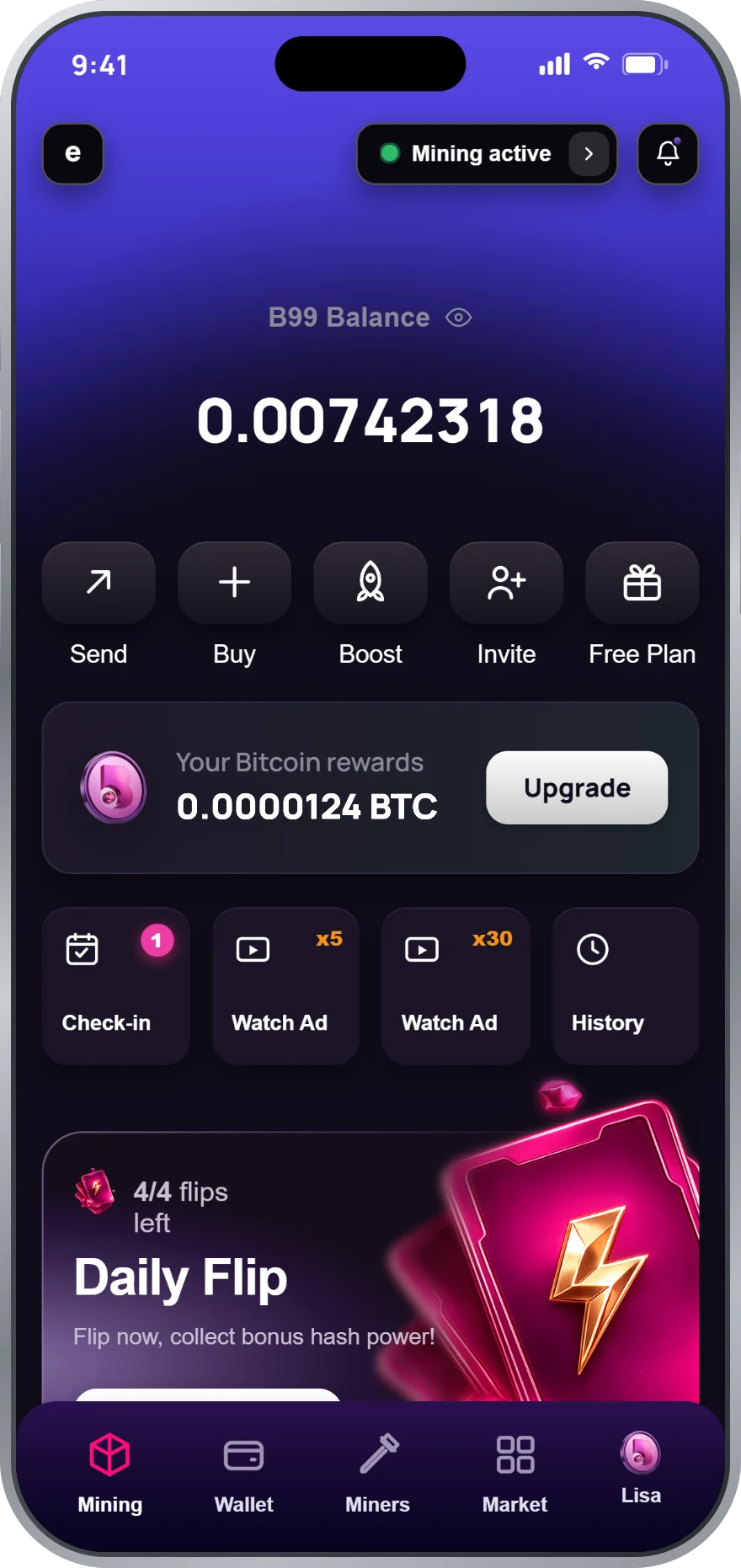
Hash power is your plan total plus bonuses. Session shows whether today's 24-hour mining window is running — start it every day. Streak counts consecutive check-ins and feeds the streak bonus. Today's rewards is your share of the last pool settlement; balance is everything not yet transferred.
Two of these are yours to influence: the session (start it daily) and the streak (do not skip). The rest follows the network.
Takeaway: Start the session, keep the streak. Everything else is the network doing its thing.
06Lightning vs on-chain transfersTwo ways to move your Bitcoin out: Lightning for speed and tiny fees, on-chain for exchange deposits and cold storage.2 min
Lightning is Bitcoin's payment layer: transfers settle in seconds for a fraction of a cent, which makes it ideal for daily-sized amounts. You paste an invoice (starts with lnbc…) generated by your wallet for the exact amount.
On-chain transfers write directly to the blockchain — slower, with network fees, but universal: every exchange and hardware wallet accepts a standard address (1…, 3… or bc1…).
Never paste an on-chain address into the Lightning field or the other way round; both are final once sent. The help center has the step-by-step guide and the current minimums.
Takeaway: Small and often → Lightning. Large or into cold storage → on-chain. Check the address twice.
Machines in the fleet
- Antminer S21 Pro
- Antminer S23 Hydro
- Whatsminer M66
- Avalon A15
- SealMiner A2
Join the Bitcoins99 community
Fleet news and campaign starts on the Telegram channel, thirty-plus answers in the help center, support that replies in 13 languages - and the app for the daily session.